

By Alexander Germanis
It has long been said: give a man a fish and you will feed him for a day; teach him how to fish and he will eat for a lifetime.
What the saying does not take into account, however, is that it often takes time to teach someone a skill and requires access to resources they do not always initially possess.
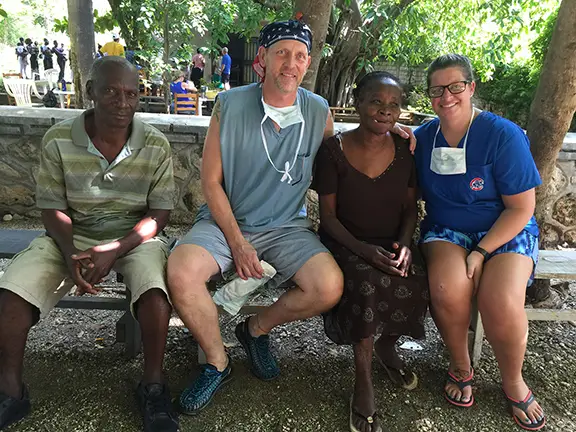
When maxillofacial surgeon Stephen Doran, DMD, of Doran, Capodice, Efaw, and Ocheltree, LLC first headed down to the Caribbean nation of Haiti in 2011, he was doing so in the footsteps of Richard and Barbara Hammond. The Hammonds were founders of the charitable organization Friends of the Children of Haiti (FOCOH), and their work has done much to bring help to the poor and destitute citizens of the beleaguered country.
After their first visits to provide medical and dental care to the people, Dr. Doran and his assistant, Maggie Barr, CNA, knew the citizens were not only in need of immediate help, they recognized there would always be that need.
Dr. Doran’s response is the most logical one: teach a man to fish. “The philosophy of this clinic is to eventually turn it over to the Haitians and have them do what we’ve been doing for the past several years,” he says. “The goal is to get out of there and go do this somewhere else, leaving this clinic in the control of Haitian doctors and nurses.”
That process will, of course, take time and effort. Teaching the local Haitians how to take care of their own is the first step. “There is one local doctor who’s very connected to our clinic and he does a lot of the follow-up the months we’re not there,” Dr. Doran shares. “But he also has a private practice, so he can’t do it all by himself.”
Developing the knowledge and talent from the ground up is the other way to help build the permanent clinic. For that purpose, Dr. Doran and his wife have been sponsoring a Haitian medical student. After he receives his education in the neighboring country of the Dominican Republic, the doctor hopes he will return and become a permanent doctor at the clinic. “I think he will; he’s a good kid,” the doctor says.
Building up the clinic does not stop there. “We’ve got some nurses that we’re sending through Haitian nursing school,” the doctor adds. “One of them has promised to come back.”
Promising to come back to the clinic is something Dr. Doran’s assistant, Maggie, has no problem doing. In fact, the doctor thinks it is more than likely Maggie will eventually go down one of these times with him and choose not to return to the States.
“I’ve been looking into moving down there permanently for about a year-and-a-half,” Maggie admits, “but I decided it’s best to finish my education first and then go down there with Doctors Without Borders or hopefully stay down there with FOTCOH and help with the clinic there — if that opportunity ever presents itself. I love it.”
Dr. Doran’s philosophy of helping others to be able to stand on their own is one he extends to those around him. Maggie is continuing her education — attending nursing school in order to better aid those in need.
“The hardest part of going to nursing school is having to, for a short time, give up being able to go to Haiti,” she says. For that reason, it is consoling to know the Haitians are “learning to fish” in the meantime.
To learn more about the work and the benefits that come from bringing better healthcare to the Haitian people, read “Healing Haiti, Part 5” in an upcoming issue of Healthy Cells.