

By Lynn Hutley, Advocate BroMenn Medical Center
We all know that breasts come in different sizes and shapes, but there is another distinguishing factor you might not be as familiar with that could impact your risk for cancer — breast density.
What does it mean?
“All breasts are made up of fibroglandular tissue and fatty tissue,” says Dr. Ajay Malpani, radiologist with Bloomington Radiology. “The more glandular the tissue, the more dense the breast. We generally categorize breast density into one of four categories, from fatty to extremely dense. All categories are considered normal.”
Besides being normal, dense breasts are relatively common. The New England Journal of Medicine reports over 40 percent of women have dense breast tissue. Dense tissue does raise the risk of developing breast cancer, however, giving women with dense breast tissue a four to six times higher risk of developing breast cancer than women with minimal fibroglandular tissue.
Additional screening
“Mammography remains the gold standard for cancer screening for all breast types,” says Brenda Downen, director of radiology at Advocate BroMenn Medical Center in Normal. “However, if you have dense breasts, your physician may recommend additional imaging using ultrasound technology.”
Dense breast tissue appears white on mammograms, as do masses or lumps. Therefore, mammography has decreased sensitivity to detect breast cancer in dense breasts.
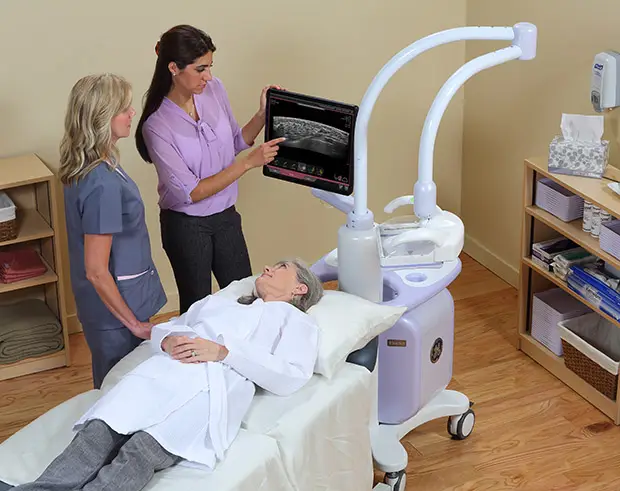
“Ultrasound uses sound waves to image the breast tissue. In women with dense fibroglandular tissue, ultrasound may detect additional cancers which may be obscured by dense tissue on mammography,” says Malpani.
There are limitations to using traditional hand-held ultrasound which prevent it from being used more commonly for screenings. However, these challenges can be addressed through the use of 3D ultrasound and accompanying software.
“The ultrasound technology we now have allows our radiologists to look at hundreds of ‘slices’ of breast tissue to see if anything is abnormal on the ultrasound,” says Downen.
As with any type of ultrasound, the procedure is free of radiation. It is performed by an ultrasound technician and is relatively painless.
Whatever the size and shape, early cancer detection remains the goal. Downen encourages women 40 and older or with risk factors to have their annual screening mammograms and to talk with their health care provider about whether or not they have dense breast tissue.
Advocate BroMenn Medical Center now offers 3D breast ultrasounds using an automated breast ultrasound system, or ABUS, at Advocate Outpatient Center, 3024 E. Empire St., Bloomington (across from the airport). ABUS has improved cancer detection by 35 percent over mammography in women with dense breasts. A doctor’s order is required for this type of imaging.
3D mammography is available without a physician referral at two Advocate locations in Bloomington-Normal: at the hospital, 1304 Franklin Ave., Normal; and at Advocate Outpatient Center in Bloomington. Same-day appointments and 24-hour results are available in most cases. For an appointment at either location, call 1-800-3-ADVOCATE (1-800-323-8622). For more information about breast cancer, visit storiesofthegirls.com.
Photo courtesy of GE Healthcare