

By Alexander Germanis
Archaeologists have long been able to determine ancient people’s lifestyles, diets, and even socioeconomic background based on their teeth. And like a small set of journals, the teeth record more and more the longer the owners have been around.
Emil Verban, Jr., DDS, of Bloomington has read more than his share of these teeth journals and, better still, knows how to restore them. But like the lives we lead, each set of teeth can differ greatly from another, therefore the work to restore them can vary as well.
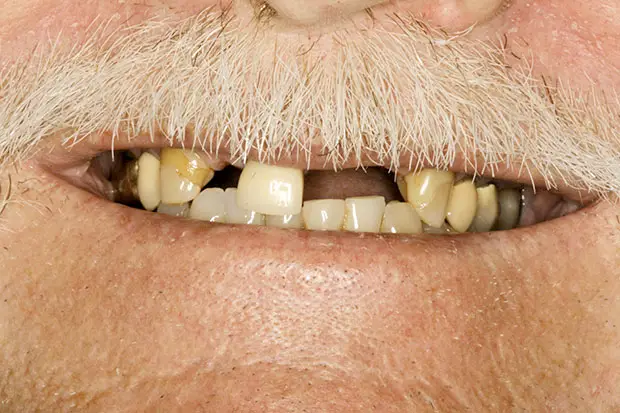
One such restoration came to a man in his 50’s with three missing upper anterior teeth — a man who had been wearing a removable partial denture for the past 25 years of his life. “He had gotten to a point where he decided he just didn’t want to wear the partial anymore,” Dr. Verban recalls. “Although he had grown accustomed to it, aesthetically he wasn’t confidant in his smile.”
During the patient’s first appointment with Dr. Verban, “A three dimensional x-ray was taken to determine if he had sufficient bone volume to place dental implants,” the doctor continues. “From that, a treatment plan was developed in which we elected to place three individual implants and cap five of his existing teeth.”
The caps were decided upon because, as the doctor states: “His teeth were stained and discolored over time; so we changed the color of the teeth with the caps while the implants eliminated him from having to wear his removable prosthesis.”
The dental implants were surgically placed during the second appointment and were then given eight to ten weeks to heal and integrate with the jaw bone. After this two month period, a set of provisional teeth were made. “The purpose of making provisionals was to design the length, size, and shape of his teeth so they would fit in with his smile as well as his speech patterns,” Dr. Verban says.
Speech is, no doubt, something most people do not reflect upon when they think of a trip to the dentist; but the doctor explains: “The position of the front six teeth are very important in being able to have good phonetics — pronunciation of certain letters like s and f. If the teeth are not positioned correctly, you will have a lisp when you speak.”
Assuring the proper fitting during the provisional stage then is of utmost importance. A diagnostic wax-up is first made to establish the assumed final size, shape, and position of the teeth. The wax-up is then duplicated with provisional teeth made out of acrylic. “It’s easy to change the acrylic by adding and subtracting from it in the provisional stage,” Dr. Verban expounds. “It’s far more difficult to do that in the final stage when they’re made out of porcelain.”
Once placed in the patient’s mouth, “Adjustments are made to take into consideration the phonetics and the smile line,” the doctor continues. From there, the laboratory gets involved. “You have to make the provisionals to give the laboratory somewhat of a roadmap to how the finals will be made. When impressions and models are taken and sent to the laboratory, there’s no face with them,” Dr. Verban chuckles, “so you have to have a way to transfer that data to the laboratory to fabricate. That’s the purpose of the provisionals.”
Dr. Verban believes it is important that patients understand the actual length of time such a process actually takes. “You can extract teeth, place implants, and make provisionals in one day,” he says. “But you still wear those provisionals for four to six months before you get your finals. That it can all be done in a day is a misconception that’s out there.”
After four months of provisional wear with this particular patient, Dr. Verban finished his restoration work. “We changed his whole smile line — the amount of tooth structure he showed — by changing the size of his teeth. This significantly increased his ability to smile with confidence.”
To learn more about what dental restoration can entail, read part two in Dr. Verban’s dental journal, available in next month’s issue of Healthy Cells Magazine®.
For more information, you may contact Emil Verban, Jr., DDS at 309-662-8448 or visit www.mcleancountydental.com. McLean County Dental is located at 2103 E. Washington Street in Bloomington. Dr. Verban provides his patients both general dentistry expertise and the ability to provide specialized services such as cosmetic procedures and dental implants.