

By Alexander Germanis
Certain things in the world are supposed to be immobile. So, when the solid starts acting more like a liquid, it can be understandably unnerving. No one likes feeling the walls of their house shake in a powerful storm. And when the ground moves beneath our feet, it is not only disturbing, it can be downright terrifying. Those feelings transfer over easily to our teeth. They should be as immobile as the ground beneath us. For some people, like Christine, however, that may not be the case.
A patient of Emil Verban, Jr., DDS, in Bloomington, Christine had periodontal problems since her high school days. “I’ve always been told I had what my dentist called ‘bleeding gums,’” she begins. “When I had my first child, I went to a periodontist in Springfield, where I lived, and he did several [gum] grafts and scrapings; they did not take. So, by the time I started going to Dr. Verban, I actually had teeth that moved—including the teeth in the front.”
With a career in education, Christine was constantly surrounded by the public. Although now retired, she still consults and does presentations for teachers. “I just refused to be standing up there with my teeth moving,” she says, “so I decided I deserve to have dental implants.”
Over the course of about three years, Christine underwent three separate procedures to replace her ‘moving teeth,’ each new subset of implants being added as her periodontal disease progressed—a disease she could do nothing to prevent. “My parents truly believed in taking care of our teeth,” she shares. “I was one of the first kids in my town to have fluoride treatment. I never had a cavity until I was 27, but these gums were horrid. Dr. Verban’s best answer was: ‘Chris, it’s hereditary.’”
Thankfully, dental healthcare has advanced to a point where heredity no longer holds permanent sway. Compromising with and compensating for one’s teeth is now a thing of the past.
“One of my lower teeth had altered my bite so much,” Christine shares, remembering her days of dental compromise, “I couldn’t chew anything hard at all. I was chewing everything to the right when that front one was loose. I would have never bitten down on a piece of meat.”
The circumstances changed drastically after the implants, however. “I had been overcompensating for that tooth not being where it needed to be for so long,” she continues, “to have one in the right place and to be able to chew correctly feels great. There’s been no difficulty adjusting; it’s wonderful.”
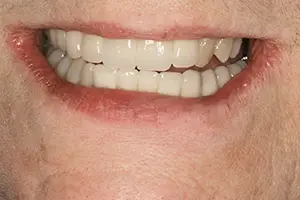
Still involved in education and the public, being able to eat was only part of the issue. For a woman who now has a “contagious smile,” Christine used to be extremely self-conscious of her smile before the implants. “I was constantly holding my hand over my mouth,” she recalls, “because I knew that tooth was not where it belonged, so it looked weird. When I talked, I kept my lips very closely shut.”
Not only is that smile much better since Dr. Verban placed the implants, it is more stable. Christine no longer has issues with gum disease and wandering teeth. As important as the stability of her new teeth are to Christine, the realistic appearance of them is equally so. “No one ever says, ‘Your teeth don’t look natural,’” she adds. “That’s what so great about it. Some people have dentures, and they don’t look right, but I don’t feel anything different. It’s as if [real] teeth are still in my mouth. I don’t even think about them not being my teeth.”
If you missed the previous articles on the dental implant procedure, you may read them online at www.HealthyCellsBN.com or contact Cheryl Eash at 309-664-2524.
For more information, you may contact Emil Verban, Jr., DDS at 309-662-8448 or visit www.mcleancountydental.com. McLean County Dental is located at 2103 E. Washington Street in Bloomington. Dr. Verban provides his patients both general dentistry expertise and the ability to provide specialized services such as cosmetic procedures and dental implants.
Photo courtesy of McLean County Dental