
By Marianne Payne, Chestnut Health Systems
As January temperatures plummet, every table is occupied at The Junction.
The community center, run by Home Sweet Home Ministries in Bloomington, IL, offers protection from the cold where folks can sip coffee, play games, and make connections.
Sean Boston arrives and greets many familiar faces. He is a community health worker representing Chestnut Health Systems™. Someone wants to meet with him, he’s told.
Boston is introduced to a new contact, “Patrick,” who had originally come to Bloomington for substance use residential treatment. He experienced re-occurrence and has been unhoused for two years since arriving.
Today was as good as any to ask for help.
He has been sleeping in the Salvation Army shelter lobby, which has been opened due to frigid temperatures. He expressed the desire to get a job. But before that, he needs to tend to the basics: restart behavioral health medications and address excruciating mouth pain.
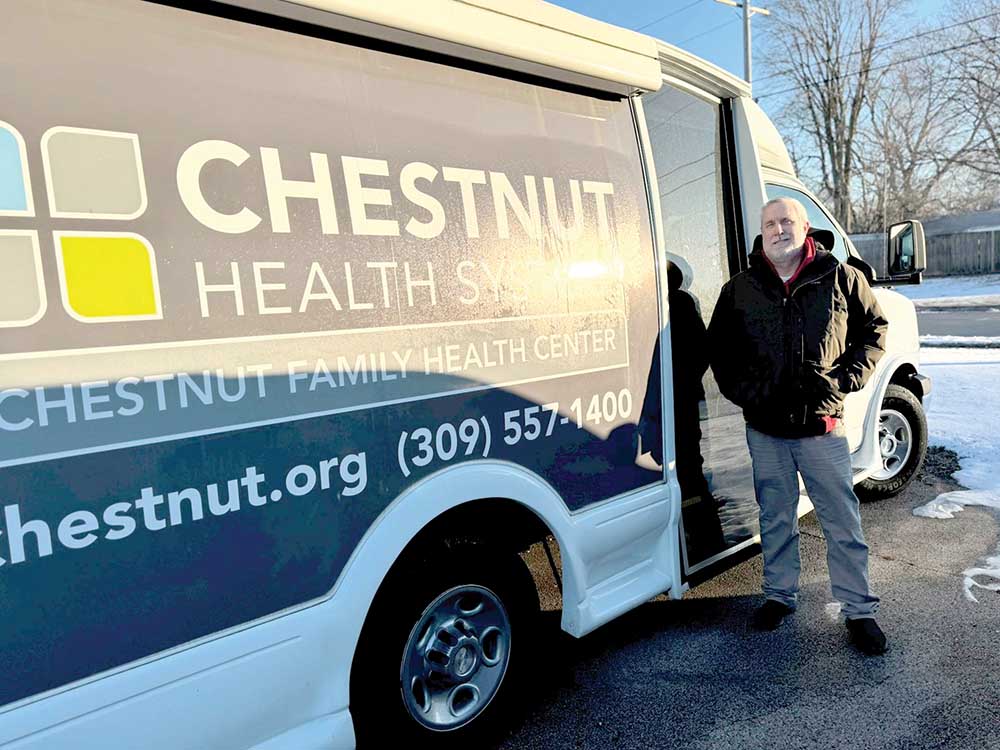
Sean books him an appointment at Chestnut’s dental office. He says Chestnut’s mobile unit, an exam room on wheels, will be parked outside the Salvation Army the next day. Sean books another appointment at the mobile unit so Chestnut’s newest client can be officially established at his new healthcare home to receive both primary and behavioral health care.
The two shake hands, marking the start of a partnership.
Community Health Workers
Community health workers are stationed on the frontlines in a revolutionary approach to healthcare. By removing barriers to care, community health workers help people navigate available human services in the area and access resources, empowering them to help themselves.
Boston, who found Chestnut as a patient, struggled to navigate Medicaid himself. He quickly fell in love with the Chestnut atmosphere and applied for a job.
“I was trying to figure this all out on my own,” Boston said. “You can find that one go-to person who can show you how to do all sorts of things. That is what I want to be for other people.”
“The type of work Chestnut is doing [Community Health Workers] is really helping bridge the gaps between service providers and ensure that people aren’t wandering around in the dark not knowing how to get where they need to go. I think that’s a big deal,” said Home Sweet Home Ministries CEO Matt Burgess.
A Collaborative Effort
Boston represents Chestnut in a meeting with various community partners to collaborate on a common mission. While Chestnut community health workers serve everyone who is on Medicaid or uninsured, the focus of this meeting is on the unhoused.
Frigid January temperatures bring more immediate needs for community partners to address. Helping people stay alive in the cold is the main priority.
With skyrocketing costs for housing, homelessness is increasingly difficult to escape. The problem is constantly evolving, from the cultural elements that contribute to isolation, down to the people themselves. Every few months, the complexion of the community shifts, bringing in new personalities to decode. The evolution of support among the community partners has grown increasingly collaborative recently, according to Boston, and is seeing results.
This regular meeting helps solidify this collaboration and allows Boston to learn about resources to share with clients, from vouchers from a local thrift shop for free clothing to a rideshare service through Connect Transit, the local public transit system.
Boston mentioned a client who recently completed Chestnut residential substance use treatment program but had nowhere to go. The team sprang into action. They identified an available studio apartment and a potential funding source for a deposit and first month’s rent. Calls were made and paperwork printed.
“We are all a piece of the puzzle to help them move forward,” Boston said. Under this model, every individual has a team behind them.
Wanting to begin a new healthcare journey but not sure where to start? Call 888.924.3786 or visit chestnut.org to request an appointment.
Chestnut’s community health worker activities are funded by the Medicaid Innovation Collaborative (MIC), a partnership between Peoria-based OSF HealthCare and four Federally Qualified Health Centers (FQHCs), including the Chestnut Family Health Center in Bloomington. Funds for MIC come from the Illinois Department of Healthcare and Family Services / Healthcare Transformation Collaboratives. The goal of MIC is to radically transform Medicaid delivery by using innovation to improve access to care, improve health care outcomes, and address unmet needs.
Chestnut Health Systems is a not-for-profit organization that has cared since 1973 for the most vulnerable in our communities. Chestnut provides substance use prevention, treatment, and recovery; mental health treatment; primary care; dental care; and housing and supportive services. It is a leader in behavioral health-related research through its Lighthouse Institute.