

By Mary Kay Holloway, RDN, CSO, LDN, Dietitian at the Community Cancer Center
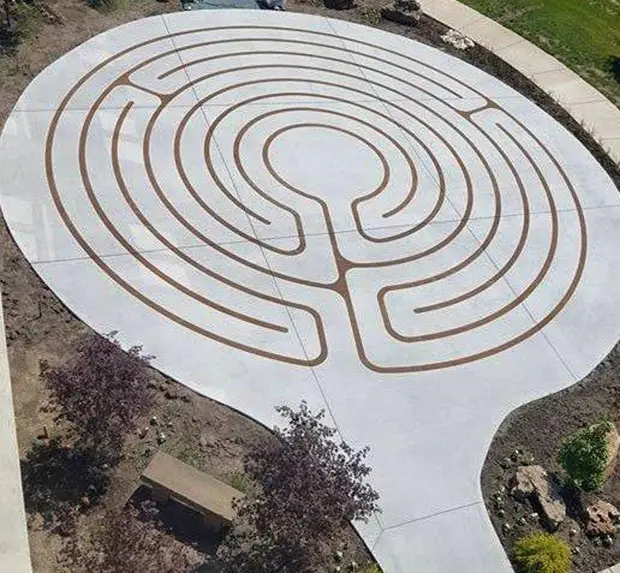
Living in our fast paced, multi-tasking society can be emotionally and spiritually draining. Strategies to calm down and clear your mind range from alcohol to walking; clearly, some strategies are better than others. One strategy would be to take a walk on a labyrinth. People are rediscovering the labyrinth as a tool for clearing the mind, releasing stress, and discovering solutions to life’s problems. So what is a labyrinth? I am glad you asked. If you looked up the definition on the internet you would get answers such as a mazelike network of tunnels, chambers or paths, either natural or man-made or any complex or confusing system of streets, passages, etc. However the labyrinth in this article is a path on a cement circle that is for meditative walking.
Labyrinths have been around for over 4,000 years and are found in most major spiritual traditions in the world. They have been an integral part of many cultures such as Native American, Greek, Celtic, and Mayan. Today, labyrinths are being used for reflection, meditation, prayer, and comfort. They are found in many sizes and shapes and created in sand, painted on canvas, fashioned with masking tape, or built with or made from vegetation.
Many people make the mistake of thinking a labyrinth and a maze are the same. A maze has dead ends and many wrong turns. A labyrinth has only one path leading to the center and walking back out again. There are no dead ends. When you walk a labyrinth, you meander back and forth. As you shift your direction, you also shift your awareness from right brain to left brain. This is one of the reasons the labyrinth can induce a more receptive state of awareness and spirituality.
Each person’s walk is a personal experience. How one walks and what one receives differs with each walk. Your walk can be a healing and sometimes very profound experience or it can just be a pleasant walk. Each time is different; there is no right way to walk a labyrinth. You only need to enter and follow the path. Remember the 3 “Rs” as guidelines for the walk — releasing, receiving, and returning.
Releasing
- To prepare, you may want to stretch and open the body/mind.
- Pause at the entrance and become quiet. Clear your mind of extraneous thoughts.
- Choose an intention for walking: physical wellbeing, inner peace, calmness, etc.
- Walk at your own pace.
Receiving
- Stay in the center as long as you wish.
- Receive clarity for your life.
- This can be a time for reflecting and meditating as well as discovering our own inner strength.
Returning
- When you are ready, exit as you entered.
- When leaving the labyrinth, express you gratitude and acknowledge any gifts you may have received during your walk.
- Reflect on your experience.
On the way out, focus on integrating strength and insight into your everyday life.
The Bloomington-Normal area has three labyrinths that can be walked. They are located at First Presbyterian Church, Wesley United Methodist Church, and the Community Cancer Center. The Community Cancer Center offers a variety of supportive and educational groups and programs, free of charge, to help patients and families cope with cancer and its effects. For a video on labyrinths, go to their website at http://cancercenter.org/spiritual-support.