

By Julie Payne, Eye Surgical Associates
Kevin Burnside was a 20-year-old college student when he first noticed a problem with his long distance vision. “It seemed to happen all of the sudden, and it got to the point where I had trouble seeing anything as far as across the street,” Kevin said. He went to his eye doctor and was diagnosed with Keratoconus, an uncommon condition in which the normally round, dome-like cornea (the clear front window of the eye) becomes thin and develops a cone-like bulge. Keratoconus literally means “cone-shaped cornea.”
Kevin’s eye sight continued to get worse. He started wearing hard contact lenses, but struggled to get a proper fit because his corneas were so misshapen. “I’d be out shopping and have my lenses continually pop out,” he said. Driving at night was almost impossible because the glare from lights made his vision even blurrier. After a series of new lenses and different doctors, he was referred to Dr. Catharine Crockett, an Ophthalmologist with Eye Surgical Associates. She told him that he needed a corneal transplant in his left eye now and might need a transplant in his right eye as well.
“The cornea is a very important part of your eye. Light enters the eye through the cornea, which refracts or focuses the light rays so that you can see clearly,” explains Dr. Crockett. When the shape or clarity of the cornea is abnormal, vision is distorted and depending on the cause, can even lead to blindness,” she explains.
There are many conditions that can affect the clarity of the entire cornea and which may lead to a corneal transplant. Trauma or injury to the cornea can cause scarring or infections. Degenerative or hereditary condition such as Keratoconus, can necessitate a corneal transplant.
There are different types of corneal transplants but all are done using a human donor cornea. With traditional, full-corneal transplant, as in Kevin’s case, a circular portion is removed from the center of the diseased cornea. A matching circular area is removed from the center of a healthy, clear donor cornea, placed into position, and sutured into place.
Kevin had his left eye corneal transplant in 2010 and then his right eye in 2012.
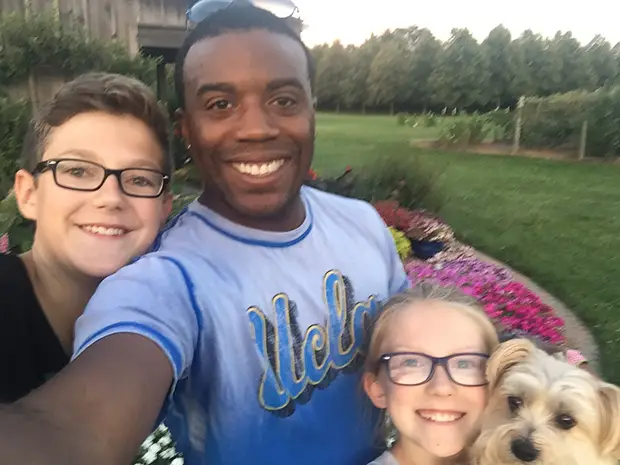
Today, Kevin is 36 years old, owner of I-Power School of Gymnastics where he is head coach for the girls’ gymnastic team. He is married with two step-children and is a soloist with the Champaign Urbana Ballet Company.
“It’s like I’ve been given a second opportunity to see,” Kevin said. Kevin is an example of more than 50,000 people each year who have their sight restored thanks to the skills of cornea specialists like Dr. Crockett and the willingness of people to register as donors.
Dr. Crockett also serves as one of the medical directors for Eversight in Bloomington. “We are very fortunate to have our own local eye bank, Eversight, that procures donor corneas and conducts all of the required tests to make sure the donated corneas are free from viruses, potentially infectious diseases, and are checked for clarity,” Dr. Crockett said.
Eversight Illinois (formerly the Illinois Eye-Bank) is a charitable, not-for-profit organization whose mission is to restore sight and prevent blindness through the healing power of donation, transplantation, and research. Annually, Eversight facilitates more than 1,400 transplants for people in Illinois. There are only two eye banks in Illinois. One in Bloomington and one in Chicago.
Each year, Eversight holds an annual event to create community awareness and to provide financial assistance to corneal transplant patients who would otherwise be unable to afford the procedure. This year, two donor families are being honored for the life-giving gifts of their beloved family member: The Michael Collins family and the Casey Kohlmeier family.
To support this important resource, mark your calendar and plan to attend.
If you would like more information or to schedule a comprehensive eye exam, contact ESA Eye Surgical Associates at 309-662-7700. Ophthalmologists Daniel Brownstone, Catharine Crockett, Scott Pinter, and Optometrist Kathleen Vize will be happy to see you. ESA is located at 1505 Eastland Drive, Suite 2200 Bloomington.