

By Alexander Germanis
One of the most common issues which plumbers are asked to deal with is clogged drains. Whether in the sink or the tub, when there is an obstruction in the narrow drainage conduit, water backs up and sometimes won’t even drain at all. Not until the clog is lessened or forced out will the water course through the pipe properly and normal function can be restored.
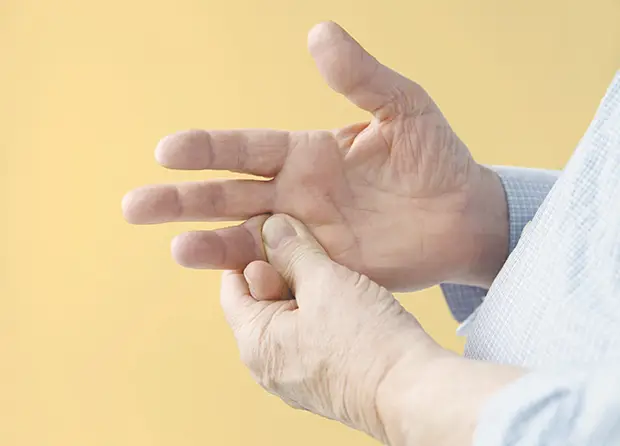
One of the most common things hand and wrist orthopedic surgeons see is trigger finger, or stenosing tenosynovitis. Like a clogged drain, the narrow tunnel of bone and fascia in each finger can be blocked up by an inflamed tendon, restricting the movement of the finger’s pulley system.
As Dr. Jerome Oakey, a hand and wrist surgeon at McLean County Orthopedics, explained in the last part of this series, a tendon can soak up a lot of synovial fluid in the joints and form a sort of clog in the tunnel. This results in the finger getting stuck in a curled, trigger-pulling position from which it needs to be forced open, hence the name of the condition.
Fortunately, there are a number of ways that have proven to reduce the swelling and relieve the condition. “One of the things that’s most effective in treating this is steroid injections,” Dr. Oakey says. Because inflammation is the root problem with trigger finger, an anti-inflammatory such as a steroid can help many patients avoid surgery.”
Although there are alternatives to steroid injections, such as therapy or splinting, Dr. Oakey points out: “There has not been a lot of documented success. And looking at how much money you’re spending on therapy sessions versus a steroid injection—a steroid injection can be the most economical way to go about it.”
But for patients who are leery of needles and wish to try less invasive options, the doctor recommends activity modification, icing the problem areas, or taking oral anti-inflammatories. “Those can absolutely all be tried first,” he says. But if the condition and pain are bad enough, Dr. Oakey’s most common recommendation is to just administer the injection.
“If the symptoms recur,” the doctor adds, “we’ll talk often about a second injection. Beyond two steroid injections we usually recommend surgery because repeated injections can cause problems with the tendons that run through the hands—such as rupture—so we don’t typically like to go beyond two.”
A subgroup within the patient population for trigger finger are diabetics, who are not only more susceptible to the condition, they do not have the same response rate when it comes to steroids. “If [the condition] comes back after the first injection,” Dr. Oakey explains, “a diabetic will most commonly opt for a surgical treatment, because a second steroid injection in a diabetic has a very low likelihood of ‘curing’ this.”
The surgical treatment is straightforward and can be performed on diabetics and non-diabetics alike. The area is numbed with a local anesthetic, although many patients opt for additional sedation, “so they won’t really care what’s going on,” he says. “I then make a small incision in the palm,” he continues, “and open up or split that pulley so the tendon can run through uninhibited.”
Again, there is a slight difference for diabetics. “When I do a surgical release on a diabetic patient,” Dr. Oakey explains, “that pulley—which in a non-diabetic is often the thickness of tissue paper—in a diabetic is often much thicker. I think as a byproduct of the diabetes, there is an alteration in the inflammatory response and healing cycle.”
Recovery time is typically fairly rapid. In about a month’s time, most patients can return to the vast majority of their normal activities.
Even though tendon synovitis can be a painful and, certainly, disruptive ailment, the methods used to relieve it are relatively simple, meaning there is really no reason for sufferers not to get their fingers “off the trigger.”
If you missed the first two articles on Trigger Finger, you may read them online at www.HealthyCellsBN.com, or call Cheryl at 309-664-2524.
For more information, you may contact Dr. Oakey at McLean County Orthopedics, www.mcleancountyorthopedics.com or 309-663-6461. The practice treats all types of orthopedic conditions and offers a comprehensive range of services. Their office is located at 2502 E. Empire in Bloomington.
Photo credit: nebari/iStock